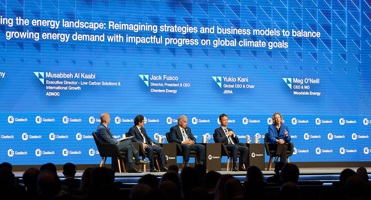
When you think back to your winning pitch in Milan, how has Qube changed most since Gastech 2025?
In Milan, Qube was an established provider of site-level continuous monitoring solutions: durable sensors placed around the perimeter of a facility, robust emissions modeling, and a platform that visualizes localized, quantified emission events. A year later, the biggest change is the product line in which we have grown from one device class into three field-tested modular solutions. Qube Fenceline for site-level localization and quantification, Qube Lite, for equipment-level detection, and Qube Camera for high resolution observation of operations. We closed a strategic funding round in February 2026, led by TC Energy alongside NGIF Capital, to scale those new products. We’ve grown to more than 8,000 devices deployed across 100+ operators and expanded into new markets and industries.
What has been the biggest breakthrough for the business since winning the Gastech Innovation Accelerator?
The biggest breakthrough has been the expansion of our product line and the improvement of the emissions modeling underneath it. At Gastech 2025 we offered one product; today we field three. Qube Lite is an intrinsically safe methane sensor that mounts directly on high-risk equipment like tank tops, thief hatches, and VRUs, and its cost supports dense deployment across an asset base. Qube Camera adds visual confirmation, so before anyone drives to a site, the operator can see whether a flare is out, a hatch is open, or a truck is loading. Alongside our fenceline devices, the three layers give an operator a quantified rate, a pinpointed source, and a picture for the same event.
Qube’s emissions modeling has advanced just as far. We have developed our own Controlled Release Test Facility (CRTF), outside of Calgary, Canada, where emissions events are simulated and every scenario is scored against ground truth. In 2025 we took the platform through METEC’s ADED 2.0 protocol in Colorado: a 13-week controlled release program with dense, overlapping emissions from more than 11 simultaneous sources, many at 0.125 kilograms per hour or lower. Qube identified the correct equipment group 96.7 percent of the time, detected releases above 5 kilograms per hour within 15 minutes at greater than 90 percent probability, and quantified group-level rates above 2 kilograms per hour to within roughly 1 percent of ground truth. Those results drove upgrades to turbulence handling, 3D source geometry, multi-source localization, and probabilistic duration modeling that are now live across the fleet.
Continuous monitoring can produce a huge amount of information. What have you learned about helping operators understand what to act on first?
The problem comes down to too much data without context. A significant methane release is only a data point until an operator confirms it, and that usually means an inspection with time spent traveling to site. The remedy is to attach a cause to the data before it reaches the operator’s desk. Routine operations like blowdowns and truck loading have recognizable signatures in the combined process (i.e., SCADA) and emissions data. Through time-bounding and localizing those events, the platform can expect those emissions and suppress a false alarm instead of alerting someone at 2 AM about a scheduled loadout. Equipment failures leave different signatures, and those alerts deserve a thorough response. Furthermore, continuous monitoring would not be a viable solution if it did not scale, both in the number of sites and complexity. In this area, we have invested heavily in our data science to capture the nuance of real-world operations.
Qube has expanded its technology from site-level monitoring to more targeted equipment-level detection and visual confirmation. What problems were customers asking you to solve?
Three questions came up in almost every operational review: 1) Where is the emission source? 2) Is it unexpected or routine? 3) Do I need to send someone to investigate?
Site-level monitoring localizes to a facility area, but a tank farm can hold a dozen potential sources close together (e.g., thief hatches, Enardo seals, relief valves, VRU connections). Operators wanted to know which unit of equipment was emitting, and we developed Qube Lite from that request. The other two questions drove Qube Camera. Before dispatching a crew, operators wanted eyes on the event to understand what activities had occurred leading up to or during it.
What are the biggest barriers preventing continuous emissions monitoring from becoming part of everyday operations?
The largest barriers are organizational.
Context
Monitoring data disconnected from operations creates work instead of removing it. This is why Qube has invested so heavily in SCADA integration and event fingerprinting. The alert must arrive with context to avoid drowning operators in more data on top of their already busy workloads.
Workflow
Continuous monitoring must slot into the LDAR programs, work order systems, and reporting processes operators already run. Qube’s continuous monitoring is approved as an alternate technology for periodic screening under US EPA NSPS OOOOb / EG OOOOc, and used to support OGMP 2.0 Level 5 Gold Standard and MiQ certification.
Framing
Where monitoring is treated purely as a compliance cost, programs stall at the pilot stage. Where it is treated as an operations tool that reduces dispatches and shortens investigations, it scales across the asset base. We’re seeing more of the industry make that shift every quarter.
Are companies beginning to see emissions monitoring as a way to improve operational performance, rather than solely meeting environmental or regulatory targets?
Yes, and it is the most important shift in this market. A methane release is a loss of primary containment, which makes it a process safety event. Every release begins as a process deviation (e.g., pressure climbing past design, volumes running high) minutes or hours before gas reaches the atmosphere, and those deviations are already tags in the historian. Continuous monitoring closes the loop between what the process data displays and what left the site. The operational returns follow: recovered gas is product, fewer unnecessary dispatches free up field teams, and faster root cause means a defensible number for the emissions inventory. When operators frame emissions monitoring in operational language, the market has matured.
What is the most unexpected thing Qube’s technology has detected in the field, and what did it reveal?
A major surprise was the detection of an underground pipeline leak by Qube Fenceline. Our system is designed to monitor surface equipment, but the Qube Fenceline devices at one oil facility kept registering a persistent methane signal with no visible source, and the localization pointed at open ground rather than any equipment area. Excavation confirmed a third-party installed buried line was leaking. A walking survey would likely have passed right over it; the gas was dispersing before it reached anything an OGI camera would frame.
It is not the only surprise. We once traced unexplained intermittent spikes at a wellsite to cattle using the valves as scratching posts, and we captured a twelve-hour plant upset caused by inlet slugging that was root-caused entirely remotely through continuous monitoring and SCADA data. From all three cases, we see that continuous data goes beyond emissions detection to help build the “why” behind each event.
What is the next major capability or result you want the industry to see from Qube?
Automated event fingerprinting at scale. Today an engineer can see process data and emissions data on one timeline, and diagnosis drops from an afternoon to minutes. The next step is codifying those signatures, so the platform recognizes them on its own. The alert should not say "methane elevated at tank farm"; it should say "venting consistent with VRU instability," with the evidence attached. The step after that is moving from mitigation to prevention: the deviations that precede a release are visible in SCADA data hours before gas reaches the atmosphere, so the platform can flag the pattern while it is still developing. Commercially, the result I want the industry to see is global proof. The economics have been demonstrated across North American basins; we intend to demonstrate the same in producing regions worldwide.
What has surprised you most since winning the Accelerator?
Continuous monitoring has moved from pilot conversation to something that is being deployed at scale globally. Five years ago, this was an innovation-team purchase; today it sits in LDAR budgets, has an EPA-approved compliance pathway, and is deployed at thousands of facilities. The Accelerator win helped us put Qube in front of international operators we were only beginning to reach.
The other surprise was in the data itself. Monitor continuously and you discover the emissions profile of a typical site is dominated by small, short, intermittent events rather than dramatic failures; across 34 sites over a full year, most detected events fell below 5 kilograms per hour. That finding changed how we build products, because the value is in catching what quarterly snapshots cannot see.
Have you changed your mind about any aspect of the market, your customers or your technology since Gastech?
I used to think of monitoring as a product decision: an operator evaluates technologies and picks a winner. I no longer believe any single technology wins on its own. The operators getting the best results pair snapshot technologies (e.g., OGI surveys, flyovers) for coverage with continuous monitoring for context, and we now design for that layered reality in our platform. I also underestimated demand outside oil and gas. At Gastech I would have called biogas, RNG, landfills, and mining a promising secondary market but it has become central to the business. In those sectors methane is often the product itself, so the case for monitoring needs no regulatory push at all. Right now, the long-term driver of this market is operational value.
What happens within a company when teams suddenly have access to real-time emissions information?
At the onset, teams discover patterns in operations and activities. Operators know every site has an emissions profile (truck-outs, blowdowns, tank venting) that is normally not laid out hour by hour. There is almost always an issue found early. Examples could be an improperly sealed hatch, or volumes too high for the VRU. As the emissions data is integrated with process data, the site roles converge. In other words, emissions data traditionally lived with the environmental team while process data lived with operations. Real-time monitoring pulls both onto the same timeline. The control room treats emission alerts like process alarms, and LDAR coordinators stop scheduling purely by the calendar and start prioritizing by evidence. At our most mature customers, emissions become a standing item at the morning operations talk, and considered along with uptime and production.
Qube is working across sectors including oil and gas, biogas, landfills and mining. Where have you seen the most unexpected opportunity?
We have seen significant opportunity in Biogas and RNG. We knew the sector was growing; and continuous emissions monitoring was a natural fit. At an RNG facility, methane is the product. Every kilogram that escapes a digester or lagoon cover is revenue lost, and often puts environmental certifications at risk. The business case could not be more clear. We partnered with one operator to monitor more than twenty lagoon digesters across Texas, Idaho, and California, and with another operator on an expansion covering one hundred lagoons. These are large, distributed assets where a torn cover can leak for months unnoticed, and where a wireless sensor network is often the only practical way to watch them. Wherever methane has value or consequence, continuous monitoring makes a strong case.
How important is regulation in turning continuous monitoring from an emerging technology into standard practice?
Regulation opens the door; operational value keeps it open. The regulatory shift of the past two years has been structural. EPA’s OOOOb rule is performance-based and explicitly allows continuous monitoring technologies, OOOOc extends that framework to existing sources through state plans, and full compliance lands by 2029. In March 2025, EPA approved Qube as an Alternative Test Method for periodic screening; Alberta and New Mexico have approved our technology as well. In plain terms, continuous sensors can now carry LDAR compliance weight in place of, or alongside, quarterly OGI, so an operator deploying today knows the investment counts. But the programs that thrive also bank the operational returns. Regulation makes continuous monitoring permissible; operations make it indispensable.
What is one thing operators often misunderstand about continuous methane monitoring?
That it is mainly a tool for catching super-emitters. The headline events shape the mental model, so operators sometimes assume a continuous system is an expensive insurance policy against a rare catastrophe. The field data tells a different story: most of what a site emits comes from small, short, intermittent events (tank flashing, liquids handling, a hatch left ajar after gauging) that quarterly surveys cannot catch, because the photograph usually happens on a quiet day. Our verified probability of detection, 90 percent at 1.5 kilograms per hour from 75 meters, exists because routine equipment behavior is where the tonnage lives. The second misunderstanding follows: fear that the data becomes a liability. In practice, a quantified, root-caused event is a defensible inventory number, which is a far stronger position than an estimate built on emission factors.
Why do some emissions-monitoring technologies scale while others remain limited to trials?
Scaling is won on unglamorous things. The first is hardware that functions accurately in the elements. A device that needs external power or gentle weather works in the lab but fails in the field. Our devices can be installed by field operators in about twenty minutes, run on solar, and operate in extreme temperatures and humidity. The second is cost per site that survives multiplication by two hundred leases; trials tolerate boutique economics, programs do not, and that discipline is why we built Qube Lite. The third is what the technology provides versus asks of the people who use it. A program scales when field ops, maintenance teams, and air compliance managers can all work with it without becoming data scientists. Our dedicated customer success team, engineers with deep oil and gas experience, supports operators from deployment planning onward. And the platform itself is intuitive and visual. Operators can visualize events on a map and timeline, track repairs through to closure, and export reports built for regulatory compliance, sustainability reporting, and certifications.