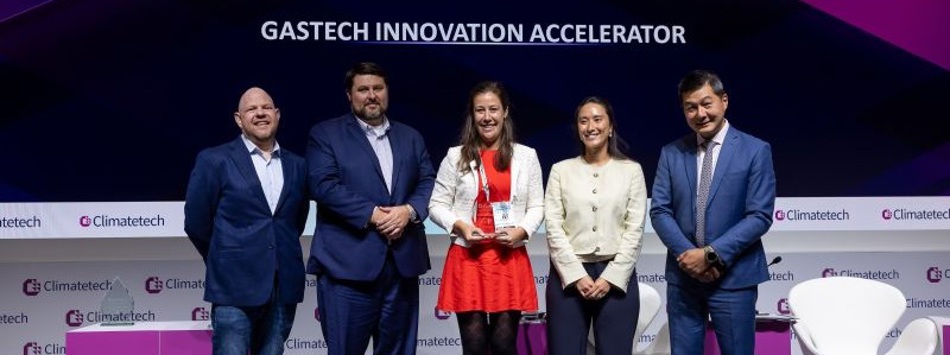





When you think back to your winning pitch in Milan, how has Highwood changed most since Gastech 2025?
The biggest change has been our evolution from helping companies understand methane emissions to helping them operationalize methane management across their organizations. At Gastech 2025, we were focused on building the industry's most trusted methane inventory platform. Today, we've expanded that vision by combining software, consulting, and deep technical expertise to help operators turn complex data into decisions. We've also significantly expanded internationally, supporting operators, LNG exporters, and national oil companies across North America, South America, Europe, the Middle East, Africa, and Asia as methane management has become a global business priority.
What has been the biggest breakthrough for the business since winning the Gastech Innovation Accelerator?
The biggest breakthrough has been proving that software alone isn't enough. Companies don't just need another dashboard, they need confidence in their emissions inventories and a clear path to improve them. We've built a business that combines technical expertise with software, allowing customers to move from fragmented data to trusted inventories that support reporting, regulatory compliance, and emissions reduction decisions. Seeing operators use our platform to improve both their reporting and their operational performance has been incredibly rewarding.
Companies now have access to more methane data than ever before. Why is turning that data into action still so difficult?
The challenge has shifted from collecting data to making sense of it. Companies receive information from satellites, drones, aircraft, continuous monitors, handheld cameras, engineering calculations, and production systems. Each tells part of the story, but none provides the complete picture on its own. The difficult part is reconciling all of those data sources into a trusted inventory and then understanding what actions will actually reduce emissions. Without that context, more data often creates more uncertainty rather than better decisions.
Where do companies most commonly go wrong when trying to understand and manage their methane emissions?
Many organizations still treat methane management as a reporting exercise rather than an operational discipline. They focus on producing a report for compliance instead of building a system that continuously improves emissions performance. The companies making the most progress are integrating engineering, operations, maintenance, measurement, and sustainability teams around a single understanding of emissions. That organizational alignment is often far more important than buying another measurement technology.
Highwood helped Triple Crown Resources achieve OGMP 2.0 Level 5 Gold Standard ahead of schedule. What did that experience teach you about what a successful methane-management programme looks like in practice?
Triple Crown demonstrated that success isn't about having perfect data from day one. It's about building a structured process that continuously improves the quality of your inventory while engaging the right people across the organization. They approached methane management as a business improvement initiative, not simply a reporting requirement. Strong leadership, clear ownership, and a willingness to challenge assumptions were every bit as important as the technical work itself.
The industry has no shortage of methane-detection technologies. How can companies make sure these different tools work together rather than creating even more fragmented data?
The industry doesn't need one technology to replace all others, it needs a framework that allows every technology to contribute where it performs best. Different measurement methods answer different questions. The real value comes from integrating those measurements into a common inventory that provides traceability, uncertainty, and context. Companies should be investing in interoperability and data integration rather than expecting any single technology to solve the entire problem.
What is one thing the energy industry still misunderstands about methane emissions data?
Measurements without context can be misleading. Good methane management isn't about collecting the largest volume of data, it's about understanding what that data represents, its uncertainty, and how it fits into the overall emissions inventory. Trustworthy inventories require both high-quality measurements and rigorous understanding of facilities, events, and other context.
What is the next major goal or proof point you want Highwood to achieve?
Our goal is to become the industry's most trusted partner for methane inventories, not just helping companies report emissions, but helping them make better operational and investment decisions. We want to demonstrate that organizations can build inventories that are trusted by operators, regulators, investors, and importers alike while using those same inventories to drive measurable emissions reductions. Ultimately, success is when methane management becomes a normal part of running an efficient oil and gas business rather than a separate compliance activity.
What has surprised you most since winning the Accelerator?
The speed at which methane has moved from being primarily an environmental issue to becoming a core business issue. Today it's influencing access to markets, financing, regulation, operational performance, and corporate strategy. The conversations we're having with executives today are fundamentally different from even two years ago.
Have you changed your mind about any aspect of the market, your customers or your technology since Gastech?
Yes. Early on, I thought the biggest challenge would be developing better technology. Today, I believe the harder problem is helping organizations operationalize methane management. The technology is advancing rapidly, but success depends just as much on governance, workflows, decision-making, and organizational alignment.
What is the hardest part of taking a methane-management programme from one site to an entire organisation?
Consistency. Every asset has different equipment, different operating practices, different data quality, and different people. Scaling requires standardized processes without losing the flexibility to address site-specific challenges. It's much more of a change-management exercise than most organizations expect.
What does good methane management look like beyond simply meeting regulatory requirements?
The best companies use methane management to improve how they operate. They identify opportunities to reduce product loss, improve reliability, prioritize capital spending, and strengthen operational performance. Compliance becomes a by-product of running a well-managed business rather than the primary objective.
Why do so many promising methane technologies struggle to move beyond the pilot stage?
Pilots often prove that a technology works, but they don't always demonstrate how it fits into day-to-day operations or delivers measurable business value. Operators need to understand not just what a technology detects, but how it changes maintenance decisions, improves inventories, reduces emissions, or lowers costs. Without that integration, even excellent technologies struggle to scale.
What is one question every operator should be asking about its methane data?
Can I explain and defend my inventory and how can I leverage it to make decisions? That question forces organizations to think beyond compliance. It requires understanding where data came from, how reliable it is, what assumptions were made, and whether it can support operational decisions. If you can confidently answer that question, you're well on your way to building a credible methane management programme.