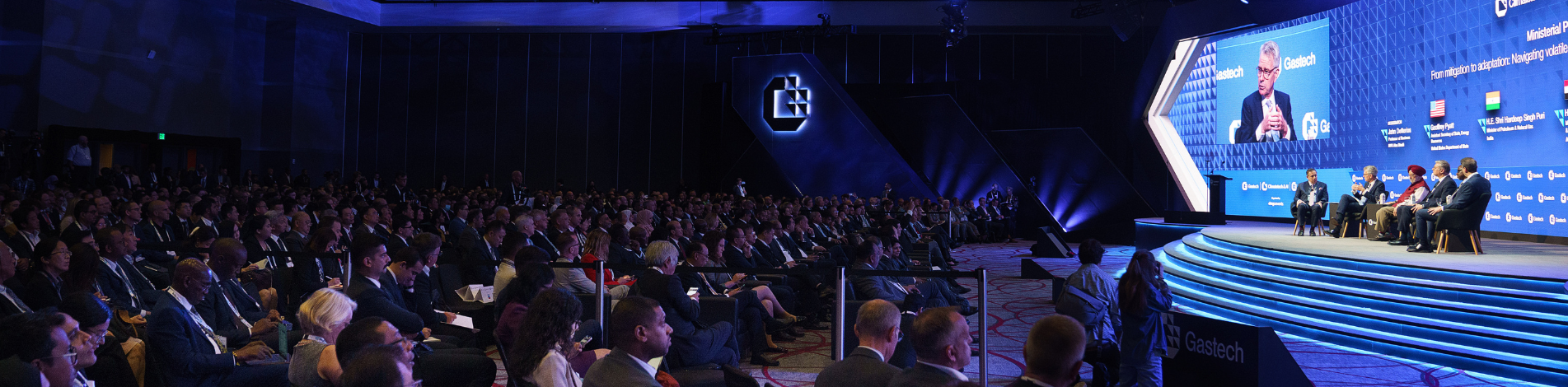
With 1,000 exhibitors, Gastech connects energy solutions and technologies with global industry leaders, decision-makers, and financiers.
Learn moreExplore solutions in natural gas, LNG, low carbon solutions, electrification and AI for energy. With 1,000 exhibitors and dedicated industry areas, the exhibition offers breakthrough innovations, new commercial opportunities, and access to Asia’s fastest-growing energy markets.
Learn moreThe Gastech Conferences serve as a critical platform for the industry, inspiring policy development, collective action, and knowledge sharing with the potential to drive technical innovation. These conferences are designed to support sustainable economic growth and deliver tangible global energy solutions.
Learn moreThe Gastech Energy Club is a prestigious, members-only platform uniting ministers, government officials, c-suite executives, and board members from world-leading energy companies.
Learn moreDiscover expert insights, interviews, and analysis from the Gastech community on the technologies, strategies, and innovations shaping the journey to net zero.
Learn moreDiscover essential travel information, local insights, and visitor guidance designed to support your journey to Bangkok for Gastech. From accommodation and transport to curated city experiences and practical travel advice, explore everything you need to make the most of your time in one of Asia’s most dynamic and internationally connected destinations.
Unlocking the unrealised potential for hydrogen and low carbon fuels in a diverse energy mix
Hydrogen and low carbon fuels are emerging as critical components of future energy systems, complementing natural gas and supporting hard-to-abate sectors. Asia is positioning itself as a key demand centre, with infrastructure and policy frameworks developing rapidly. Gastech convenes leaders to explore how to scale production, optimise transport and storage, and integrate these fuels into existing networks to build a more resilient an diversified energy mix.
The hydrogen sector is recalibrating as early optimism gives way to natural attrition and a pragmatic reassessment of market realities. Yet the sector’s underlying momentum remains significant, with US $110bn in committed investment worldwide, and investment growing by more than 50% each year during the past five years.With natural gas and LNG still essential to the energy mix, hydrogen’s credibility will hinge on proven use cases and clear commercial viability. Progressing projects from ambitio... Read More

Regulatory uncertainty and a lack of secure investment and offtake remain critical barriers to hydrogen market development. Project developers often face a circular challenge: financiers hesitate to invest without clear demand signals, whilst potential buyers are reluctant to commit before seeing demonstrable project success.Targeted policy intervention can break this cycle. Across the EU, USA, Japan, and South Korea, coordinated action could unlock up to 8mtpa of clean hydrogen demand by 2030 [... Read More

The European Commission notes that only 24% of workers in the EU’s energy industry are women, with the share being even lower in the hydrogen sector. Global data is lacking, an issue which is being tackled by UNIDO and Women in Green Hydrogen through their new H2 Gender Survey.Join our panel of innovators who are forging their careers in hydrogen for an open and honest conversation about the challenges faced, opportunities taken, and success they have built.Speakers will share insights into thei... Read More
After its early surge in development, funding cuts and project cancellations have put pressure on the hydrogen market. However, this has streamlined the development pipeline: projects that remain are backed by solid business cases, regulatory support, and near-secure offtake, with around 80% of committed global offtake concentrated in ammonia, refining, and power [Hydrogen Council].Economies of scale remain elusive, but existing demand centres and early successes provide a foundation for growth.... Read More
Ammonia accounts for 43% of offtake from global hydrogen projects, and half of all southeast Asian hydrogen demand [Hydrogen Council]. Its ability to decarbonise hard-to-abate industries such as steel, cement, and shipping, is a key strategic advantage. However, research shows that the maritime industry represents only 1% of binding offtake, revealing significant untapped potential [Hydrogen Council].Although high production costs are a barrier to widespread use, ammonia’s status as a globally t... Read More
Renewable gases (including biogas, biomethane, and other renewable gaseous fuels) offer an underutilised pathway to energy security and decarbonisation. Blending with hydrogen enhances flexibility across hard-to-abate sectors, while waste-based feedstocks unlock new low-carbon production pathways.Biomethane's compatibility with existing gas infrastructure accelerates deployment, with plants averaging just a one-year wait for grid connection [IEA]. New policies supporting biogas and renewable gas... Read More
As Japan accelerates decarbonisation while managing rising energy demand, cross-border infrastructure is moving to the centre of its strategy. Japanese companies are advancing CCUS feasibility studies, CO₂ shipping pilots and offshore storage partnerships across Southeast Asia, alongside expanding LNG import capacity and early-stage hydrogen and ammonia supply chains. With significant storage potential and established gas infrastructure, ASEAN markets are becoming critical partners in delivering... Read More
As governments pull back on financial and policy support for environmental commitments, the hydrogen market faces uncertainty. Critics argue that relying on subsidies stops the market from becoming commercially viable. However, supporters praise the progress enabled by financial incentives, and believe in their impact on hydrogen’s future success. Should governments champion lower carbon fuels for the good of society, or must technologies be commercially viable without subsidies to gain wider ad... Read More
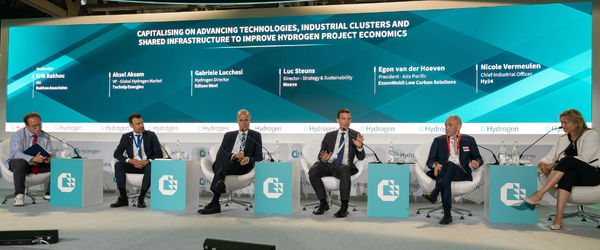
Industrial hubs, technology alliances, and shared innovation are cornerstones of hydrogen market development. Cross-border partnerships – export corridors, offtake agreements – and cross-company collaborations through industrial clusters and shared infrastructure reduce costs and lower investment risk.When technology providers, financiers, developers, and governments align, early ambition can become lasting commercial success. Understanding what makes these partnerships work is key to scaling th... Read More
Japan, the first country to adopt a national hydrogen strategy, is a leading testbed for scaling clean hydrogen and ammonia, accelerating commercial trials, and incentivising adoption across power generation, industry and transport, as a part of its wider Green Transformation (GX) strategy. However, production, storage and transportation costs for the sector remain high, comparative to conventional fuels. With the need for Japan to import hydrogen in a volatile global supply chain environme... Read More
Solid-state hydrogen storage at low pressure and near-ambient temperature based on Nobel Prize-winning scienceDr. Neel Sirosh, CTO, H2M0FSafe and efficient storage remains one of the major barriers to wider adoption of hydrogen. The currently available best-in-class storage solutions require energy-intensive compression or liquefaction, costly infrastructure, and complex safety systems. In many projects, the delivered price of hydrogen is up to ten times the production cost, driven primarily by ... Read More
Nigeria's hydrogen driven transition: A regulator's perspective on cost competitiveness, pricing, and market signals Francis Alabo Ogaree, Executive Director, Nigerian Midstream and Downstream Petroleum Regulatory AuthorityHydrogen is increasingly promoted as a critical enabler of energy transition and industrial decarbonisation; however, its large-scale deployment in gas-rich economies is ultimately constrained by economics rather than technology. For Nigeria, the feasibility of producing ... Read More
Benchmarking emerging chemical looping technology for blue hydrogen production Luigi Crolla, Head – Energy Transition Technologies, KentThis paper will compare chemical looping reforming (CLR) technology which can be used to produce blue hydrogen, against advanced commercially available processes which use solvent-based technology. The comparison will be based on 300MW and 1000MW scales and will focus on areas such as hydrogen efficiency, carbon capture rates and energy requirements, along ... Read More
Leading the charge in ammonia-based low-carbon hydrogen for the industry and power generation Mirko Huebel, Director HyCO Product Line, Air Liquide Global E&C SolutionsThe transition to a low-carbon energy system hinges on scalable and logistically viable hydrogen carriers. For key regions like North East and Southeast Asia, the priority is twofold: deep decarbonization and maintaining energy grid resilience. Ammonia has emerged as a prime candidate for long-distance hydrogen transport,... Read More
Establishing an engineering basis for implementing interim safety requirements for liquefied hydrogen carriersMotoki Sakagami, Technical Engineer, ClassNK Liquefied Hydrogen is attracting increasing attention as an energy carrier capable of enabling large-scale and long-distance transport of renewable energy, and the development of liquefied hydrogen carriers is progressing toward commercial deployment. Due to the extremely low temperature of liquefied hydrogen (approximately -253 °C)... Read More
Full-scale qualification of a 36% Ni alloy pipe-in-pipe system for liquid hydrogen infrastructure deployment Aurelien Damour, Innovation Expert, ITP Interpipe, ITP InterpipeThe large-scale deployment of liquid hydrogen (LH₂) infrastructure requires safe, reliable, and industrially scalable transportation solutions. Dedicated LH₂ pipelines are expected to play a central role in enabling hydrogen liquefaction hubs, import/export terminals, ports, and airport distribution networks. This p... Read More
Diagnosing recurring weldment cracking in high‑pressure syngas heat exchangers through advanced CFD analysis Farahidayu Abd Malek, Lead CFD Engineer, WoodAs hydrogen adoption accelerates across energy, chemicals, and emerging hydrogen infrastructure, integrity failures driven by hydrogen‑related degradation remain among the most catastrophic yet least understood risks. Ammonia production units, which routinely handle high‑pressure hydrogen‑rich synthesis gas, provide critical insights into ... Read More
The Strategic Hydrogen Programme unites energy leaders to tackle hydrogen’s challenges and opportunities. It drives collaboration across the value chain, addressing safety, infrastructure, and policy alignment, while advancing commercial viability through investment, partnerships, and market development.
The Technical Hydrogen Programme provides vital insights into this fast-evolving industry, highlighting the critical technologies and advancements required to achieve a sustainable and commercially viable hydrogen market. This curated programme explores topics including hydrogen storage and pipelines, innovation in technology and electrolysis design, low-carbon hydrogen production, and enhanced safety protocols.
By booking your delegate pass, you will gain access to senior decision-makers, market-moving insights, and high-level networking opportunities across the Gastech Conferences.
At the Gastech Exhibition, the Hydrogen industry area will showcase the latest advancements in hydrogen production, transport, storage and utilisation. Bringing together technology providers, producers, investors and policymakers, it provides a global platform to explore innovations, build partnerships and accelerate hydrogen’s expanding role in the energy mix.
The Gastech Innovation Accelerator connects start-ups, innovators and industry leaders to showcase transformative energy technologies, gain direct exposure to key stakeholders, and drive progress toward a lower-carbon future.
Start-ups can pitch solutions in climate tech, hydrogen, and AI, while industry professionals discover scalable innovations to improve operations and sustainability.
Participation is open to exhibiting start-ups, with selected innovators receiving enhanced visibility and support.
dmg events is an international exhibition and conference organiser, publisher and information provider to the Energy, Construction, Plastics, Coatings, Manufacturing, Transport, Design and Hospitality industries.