Discover the technologies, solutions, and companies shaping the future of energy. Connect with exhibitors across natural gas and LNG, low carbon solutions, electrification, and AI for energy.
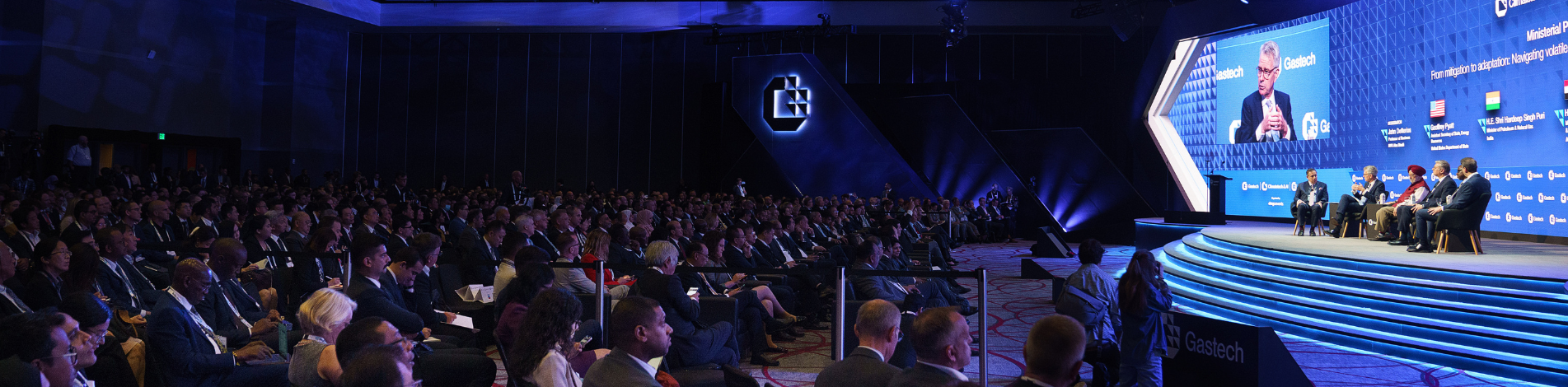
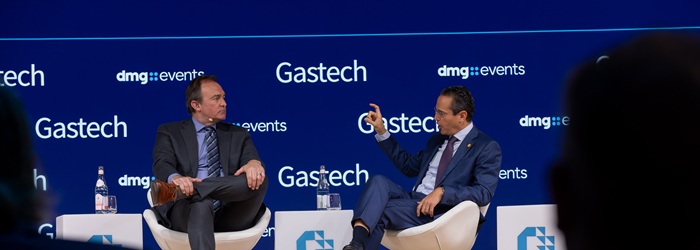
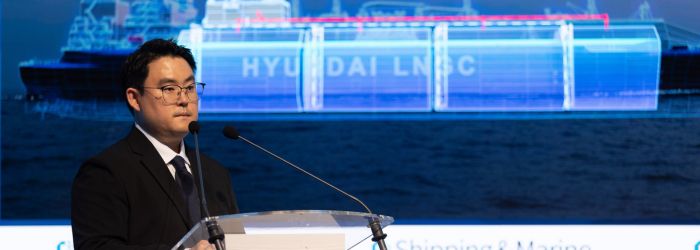
The Gastech Conferences serve as a critical platform for the industry, inspiring policy development, collective action, and knowledge sharing with the potential to drive technical innovation. These conferences are designed to support sustainable economic growth and deliver tangible global energy solutions.
The Global Energy Club is a prestigious, members-only platform uniting ministers, government officials, c-suite executives, and board members from world-leading energy companies.
Discover expert insights, interviews, and analysis from the Gastech community on the technologies, strategies, and innovations shaping the journey to net zero.
Aligning industry capabilities and partnerships to advance a more secure energy future
The evolving energy landscape requires collaboration across borders, sectors, and technologies. From LNG diversification to hydrogen and advanced tech deployment, coordinated action is critical. Gastech will bring together governments, industry, and technology partners to forge integrated alliances that drive investment, innovation, and long-term energy security for a sustainable, resilient future
Monday, 14 September | 12:15 - 13:00Supply Chain & Procurement
Resilience as strategy: Redesigning global supply chains for a fragmented world
Global energy supply chains, long optimised for efficiency and cost, are being reshaped by geopolitical fragmentation, from expanded sanctions and export controls to tariff escalation. Disruption is now structural, not episodic, demanding long-term adaptation over short-term mitigation. Resilience is emerging as a core design principle, with supply chain leadership increasingly positioned as a strategic function. Companies are reassessing geographic concentration, supplier dependencies and sourc... Read More
Monday, 14 September | 15:00 - 16:00Supply Chain & Procurement
The execution gap: Securing contractors, capacity and critical minerals in a constrained global market
Investment momentum across LNG, gas and wider energy infrastructure is colliding with finite execution capacity. Constrained EPC bandwidth, skilled labour shortages and extended equipment lead times are dictating project sequencing, with access to delivery slots now as competitive as access to capital. These pressures are structural, driven by simultaneous demand across sectors, an ageing workforce and manufacturing concentration that cannot scale at the pace investment requires. Tightening expo... Read More
Monday, 14 September | 16:15 - 16:45Strategic Leadership
Regulate or stagnate: The policy choices that will define the next decade
Energy regulation is becoming more interventionist, shifting focus from efficiency to capacity, resilience and strategic reserves as governments respond to volatility and supply concerns.A key challenge is funding new capacity, including gas storage, while keeping markets attractive to investors. At the same time, policy tensions are rising as ambitious methane and carbon targets test short-term feasibility, raising a broader question: should regulation enable the transition or actively force it... Read More
Tuesday, 15 September | 11:30 - 12:30Supply Chain & Procurement
Sharing risk and securing delivery through strategic partnerships
Rigid, price-led contracting frameworks are under strain. Inflation variability, tariff unpredictability and shifting cost structures are increasing project risk for operators, contractors and suppliers alike, with traditional models that concentrate risk on one party contributing to delays, cost escalation and delivery failures. Short-term awards and aggressive cost compression are proving insufficient where delivery reliability and schedule confidence are paramount. Energy companies are re-exp... Read More
Tuesday, 15 September | 14:45 - 15:30Strategic Leadership
Trading the LNG market: Contracting, optionality and portfolio advantage
LNG markets are becoming more dynamic and trade-driven, with freight, routing and timing increasingly shaping value. For traders, success lies in optimising cargoes across routes and counterparties, not just regional price spreads. This is reshaping contracts. Flexibility, diversion rights and portfolio breadth are now key advantages, while buyers weigh concentration versus diversification. Long-term deals remain vital but must evolve to keep pace with a more fluid, trader-led market.Audience in... Read More
Wednesday, 16 September | 12:15 - 13:00Hydrogen Strategic
Scaling through partnerships: Driving progress in the hydrogen industry
Industrial hubs, technology alliances, and shared innovation are cornerstones of hydrogen market development. Cross-border partnerships – export corridors, offtake agreements – and cross-company collaborations through industrial clusters and shared infrastructure reduce costs and lower investment risk.When technology providers, financiers, developers, and governments align, early ambition can become lasting commercial success. Understanding what makes these partnerships work is key to scaling th... Read More
Wednesday, 16 September | 14:30 - 15:00Future Leaders
From guidance to greatness: Defining mentorship goals to ensure a productive and beneficial relationship
The future of energy depends on today's executives providing genuine leadership and vision, whilst understanding what tomorrow's talent needs in return.Representative leadership matters. Relatable role models drive real career growth, and employees with mentors were promoted nearly twice as often as those without between 2023–2025 [McKinsey]; yet, women remain less likely to have them, creating tangible barriers to progression.Effective mentoring also requires employees to take ownership: settin... Read More
Wednesday, 16 September | 15:00 - 15:30Strategic Leadership
Advancing sustainable maritime infrastructure and fleet capacity
Global shipping is at a turning point, with regulation, technology and climate goals accelerating the shift to low-carbon fuels. The IMO’s Net-Zero Framework introduces fuel standards and carbon pricing to cut emissions across most oceangoing vessels. LNG is playing a near-term role, supporting emissions reductions as alternative-fuel fleets expand. Delivering the transition will require major investment in bunkering, ports and shore power, alongside stronger coordination across industry and pol... Read More
Wednesday, 16 September | 15:30 - 16:00Strategic Leadership
Powering the impossible: Reimagining energy for hard-to-abate industries
Heavy industry, spanning steel, cement, chemicals, aluminium, shipping and aviation, accounts for nearly 40% of global emissions. Decarbonisation is constrained by energy intensity, long-lived assets, complex supply chains and mixed policy signals. Solutions exist, from electrification to hydrogen and carbon capture, but progress depends on integrated approaches. Cross-sector partnerships and new energy systems will be critical to align capital, policy and demand, turning hard-to-abate sectors i... Read More
Tuesday, 15 September | 16:30 - 17:00Strategic Leadership
Building supply chains that bend without breaking: Geopolitics, trade and the new rules of energy delivery
Global energy supply chains are under strain, with disruptions exposing fragile chokepoints and the speed of geopolitical shocks. Shipping has shifted from logistics to a strategic lever shaping cost, access and delivery.Rising LNG tanker capacity is redefining routing and commercial strategy, influencing flexibility, arbitrage and market liquidity. Meanwhile, trade tensions and industrial policy are reshaping sourcing, making diversification, flexible shipping and closer public-private coordina... Read More
Wednesday, 16 September | 10:30 - 11:15Electrification Strategic
Regional grids, cross-border trade, and Grid 2.0
When a single maritime chokepoint threatened an entire continent’s energy security, regional electricity interconnection shifted from an efficiency argument to a sovereignty imperative. Yet power networks are under sustained strain from data centres, AI infrastructure, and industrial electrification, with congestion and ageing infrastructure slowing renewable integration. The ASEAN Power Grid is Southeast Asia’s most ambitious integration framework, but investment has not kept pace. Delivering G... Read More
Tuesday, 15 September | 15:30 - 16:15Electrification Strategic
Critical minerals: Securing the supply of rare earth metals to underpin the electrified economy
Electrification risks trading fossil fuel dependency for a new reliance on the supply chains underpinning clean energy technologies. Lithium, cobalt, nickel, rare earths, and copper are unevenly distributed, and processing infrastructure is heavily concentrated in a small number of markets. The 2026 disruptions made this an operational urgency. Building resilient supply chains requires international partnerships, investable project development in underexplored regions, permitting reform, and str... Read More
Monday, 14 September | 16:45 - 17:15Strategic Leadership
The new LNG order: Leadership strategies for energy security and growth
As energy security climbs the global agenda, LNG is emerging as a critical enabler of economic growth, power system reliability and industrial competitiveness. Yet as the markets become increasingly complex, shaped by geopolitical tensions, shifting trade corridors, evolving carbon policies and surging power demand from AI and digital infrastructure, demand for gas and LNG is surging. With competition for supply intensifying and investment decisions carrying long-term consequences, how can indus... Read More
Tuesday, 15 September | 13:30 - 14:30Supply Chain & Procurement
Building the supply chain workforce for a more complex delivery environment
As supply chains grow more complex and strategically significant, the demands on procurement professionals are fundamentally shifting. The traditional transactional buying function is no longer fit for purpose – organisations need professionals equipped with market intelligence, commercial strategy and supplier engagement capabilities to operate in a volatile, high-stakes delivery environment. Embedding procurement expertise earlier in the project lifecycle is becoming essential to de-risk execu... Read More
Explore the Gastech Conferences
Strategic Conference
Join senior policymakers, CEOs, and industry leaders for high-level discussions on the forces transforming the global energy landscape.
Explore investment strategies, energy security, infrastructure development, and cross-industry collaboration driving the transition to a resilient energy future.
Technical & Commercial Conference
Dive into the technologies and commercial solutions accelerating real-world energy transformation.
Learn from experts presenting cutting-edge innovations, engineering breakthroughs, and scalable solutions enabling a lower-carbon energy system.
Join the global energy conversation
By booking your delegate pass, you will gain access to senior decision-makers, market-moving insights, and high-level networking opportunities across the Gastech Conferences.