HOSTED BY
CO-HOSTS
NATIONAL CONSORTIUM PARTNERS

Exhibition & Conference

14 - 17 September 2026

Natural Gas & LNG agenda

Monday, 14 September | 10:00 - 11:00 Strategic Leadership

The energy reset: Who controls power in the new global order?

Power demand is surging while supply chains fracture and infrastructure become strategic. Governments are rethinking how energy is built, secured and financed as geopolitical shocks expose fragile markets. Hard choices loom between sovereignty, cost and decarbonisation: coal, renewables, or flexible LNG. As electrification, industry and urban growth accelerate, natural gas and LNG remain essential, delivering reliable baseload power and anchoring a resilient, diversified energy system.Audience i... Read More

Monday, 14 September | 12:00 - 12:20 Strategic Leadership

Hardening the grid: Protecting critical energy infrastructure in a contested world

As geopolitical tensions and hybrid threats intensify, energy infrastructure is increasingly exposed to physical attack, cyber intrusion and strategic sabotage. From pipelines and LNG terminals to grids and control systems, resilience is now a matter of national and economic security. Military, government and energy leaders are aligning to anticipate, deter and respond to multi-domain threats while maintaining continuity of supply. This includes infrastructure hardening, real-time monitorin... Read More

Monday, 14 September | 12:00 - 12:45 Strategic Leadership

Demand surge, system strain: Asia’s energy stress test

Emerging Asia is at the centre of surging energy demand, with growth driven by industrialisation, digitalisation and rising populations. Power systems are under strain from infrastructure gaps and fuel risks. The priority is securing reliable, affordable electricity. Gas and LNG are critical for grid stability, supply diversification and industrial growth, especially where alternatives fall short. Progress hinges on market reform, transparent pricing, stronger utility finances and deeper region... Read More

Monday, 14 September | 12:40 - 01:00 Strategic Leadership

Recalibrating cross-border LNG investments to anchor regional stability

As Middle East conflict reshapes energy markets, gas flows are fragmenting and risk is being repriced. LNG investment is shifting from volume growth to regional resilience and stability.  Cross-border projects are being redesigned to share infrastructure, align regulation and distribute risk. Floating assets, modular terminals, and integrated pipelines, storage and shipping networks are enabling systems that can flex as trade routes shift.  Governments, NOCs and private capit... Read More

Monday, 14 September | 02:20 - 02:40 Strategic Leadership

From volatility to vision: Building markets that reward stability and innovation

With geopolitical conflict amplifying disruption, energy markets are moving beyond cycles of volatility into a more structurally fragmented phase. Price signals are increasingly shaped by security concerns, supply realignment and shifting trade routes, challenging traditional investment models. For producers, consumers and investors, stability now depends on clearer long-term signals, coordinated policy frameworks and stronger producer–consumer alignment. Market structures are under pressur... Read More

Monday, 14 September | 02:45 - 03:30 Strategic Leadership

Keeping gas competitive: Navigating fragility at the heart of global gas markets

Natural gas is entering a more complex era. Hopes of prolonged LNG oversupply have faded, replaced by tighter markets, price volatility and fierce competition for cargoes, especially in Asia. High prices are slowing demand in sensitive economies, raising risks of fuel switching and long-term demand loss as power, industry and data centres seek alternatives. Keeping gas competitive will require flexible supply, strategic storage and coordinated approaches, echoing oil stockpiling, to manage volat... Read More
Monday, 14 September | 03:00 - 03:20 Strategic Leadership

Power multiplied: Africa’s energy systems as engines of global competitiveness

Africa accounts for around 20% of the world’s population but less than 4% of global electricity consumption, a gap that continues to constrain industrial output, productivity and export capacity. Power costs in several African markets remain two to three times higher than in industrial economies, shaping where manufacturing, data centres and energy-intensive industries locate. The continent holds around 7% of global gas reserves and significant renewable potential, positioning energy as both a d... Read More


Monday, 14 September | 03:30 - 04:15 Strategic Leadership

LNG in the age of electrification: Contracting, competition and demand realities 

Electrification is driving global power demand, but LNG’s role is diverging. In Southeast Asia, urbanisation and cooling needs sustain gas-to-power growth; in mature markets, gas competes with renewables and storage. For buyers, the challenge is strategic: securing long-term supply in a tightening market while managing volatility, infrastructure constraints and shifting climate policy. Flexibility now matters as much as baseload. As renewables and batteries scale, the question is when they can m... Read More

Monday, 14 September | 03:40 - 04:00 Strategic Leadership

The new regulators: Designing energy frameworks for speed, security and transformation

As geopolitical shocks expose system vulnerabilities, regulators are becoming architects of resilience. Frameworks are now judged on their ability to withstand disruption and maintain continuity under stress, not just efficiency or decarbonisation.  Permitting, market rules and network regulation are being redesigned to mandate flexibility. Requirements for storage, spare capacity, fuel diversity, demand response and interoperability are helping systems adapt as conditions shift. ... Read More

Monday, 14 September | 04:15 - 05:00 Strategic Leadership

Regulate or stagnate: The policy choices that will define the next decade

Energy regulation is becoming more interventionist, shifting focus from efficiency to capacity, resilience and strategic reserves as governments respond to volatility and supply concerns.A key challenge is funding new capacity, including gas storage, while keeping markets attractive to investors. At the same time, policy tensions are rising as ambitious methane and carbon targets test short-term feasibility, raising a broader question: should regulation enable the transition or actively force it... Read More

Tuesday, 15 September | 10:00 - 10:45 Strategic Leadership

From molecule to market: Building LNG infrastructure to connect demand centres in an era of energy crisis and supply chain disruption

The ability to deliver new LNG into the global market is increasingly dependent on EPC strategies that can accelerate project delivery while managing growing supply chain risks. With global LNG demand projected to rise by around 60% by 2040, driven by Asia’s industrial growth, emissions targets and surging electricity needs from AI and data centre expansion, the pressure to develop infrastructure quickly and reliably is intensifying. Compounded by escalating geopolitical tensions and growing ins... Read More

Tuesday, 15 September | 10:45 - 11:30 Strategic Leadership

Intelligent LNG: Transforming production, markets and shipping with AI

AI is rapidly reshaping the LNG value chain, offering new opportunities to enhance reliability, reduce costs and optimise decision-making from production to delivery. As global appetite for LNG grows, producers and traders are under increasing pressure to boost efficiency and extract more value from every molecule.Across liquefaction plants, AI‑enabled predictive maintenance, digital twins and automated process optimisation are reducing unplanned downtime and improving energy efficiency. In ship... Read More

Tuesday, 15 September | 11:30 - 12:15 Strategic Leadership

Securing LNG supply through next-generation liquefaction, modularity, regasification and digital optimisation technologies

Next generation liquefaction is emerging as the backbone of future LNG competitiveness, unlocking faster delivery, lower costs, and greater operational flexibility across the value chain. With IEA forecasting over 300 bcm of new liquefaction capacity under development through 2030, global players are increasingly relying on advanced engineering solutions to bring projects online at pace and scale. Alongside advances in liquefaction, the rapid deployment of flexible regasification infrastructure ... Read More

Tuesday, 15 September | 11:30 - 12:15 Japan Energy Strategic

Harnessing Japanese energy diplomacy at a global inflection point: Strengthening supply resilience, diversification, and strategic partnerships

As Asia navigates an increasingly complex geopolitical and economic landscape, Japan is redefining the role of energy diplomacy in support of both national energy security and wider regional resilience. Building on the priorities of the 7th Strategic Energy Plan, policymakers are adopting a more integrated approach to supply diversification, economic security, infrastructure development, and cross-border cooperation. As governments and industry confront growing uncertainty across trade routes, s... Read More

Tuesday, 15 September | 12:15 - 01:00 Japan Energy Strategic

Transforming Japan’s energy mix: Diversifying and stabilising a future-ready energy system

Japan’s energy system is undergoing a period of far-reaching structural recalibration. As a major importer and industrial energy consumer, external market shocks in 2026 and longer-term demand growth projections have urgently accelerated the need to redefine Japan’s energy mix – optimising the balance between hydrocarbons, nuclear power, renewables and alternative fuels. A national strategic focus already prioritising supply chain stability is also pivoting sharply towards system-level resi... Read More

Tuesday, 15 September | 12:15 - 01:00 Strategic Leadership

New supply, uncertain demand: Where the next gas is coming from - and do we even need it?

Recent disruptions to key supply routes have transformed a well-supplied gas market into a more constrained and uncertain one. The loss and redirection of volumes has underscored how quickly global balances can shift, and how concentrated supply and infrastructure remain across both LNG and pipeline systems. Attention is turning to the need for greater supply diversity, expanded system capacity and more flexible routes to market. New and underutilised sources of gas, alongside existing producers... Read More

Tuesday, 15 September | 02:00 - 02:45 Strategic Leadership

Fuel choices and flexibility: The next phase of Asia’s LNG growth

Asia’s fast-growing economies are central to global LNG demand, even as tighter markets and higher prices strain energy systems. Urbanisation, industrial growth and rising power use are driving the need for reliable, affordable gas, while increasing sensitivity to volatility. In Southeast Asia, LNG supports grid reliability; elsewhere it competes with coal, renewables and nuclear. Sustaining demand will depend on infrastructure, diversified supply and contract flexibility in a tighter market.Aud... Read More

Tuesday, 15 September | 04:15 - 05:00 Japan Energy Strategic

Powering Japan’s next industrial boom: Meeting energy demand from data centres, semiconductors and advanced technology manufacturing

Japan is experiencing a major boost in energy-intensive industries, with semiconductor fabrication plants, AI supercomputing centres, EV manufacturing hubs, and precision-materials facilities growing rapidly. Japan’s trajectory as a world-leading high-value manufacturing powerhouse is transforming energy demand patterns and accelerating the need for high-volume, cost-efficient clean power. This industrial expansion is impacting LNG procurement, power purchase agreements, grid planning and corpor... Read More

Tuesday, 15 September | 02:45 - 03:30 Strategic Leadership

Trading the LNG market: Contracting, optionality and portfolio advantage

LNG markets are becoming more dynamic and trade-driven, with freight, routing and timing increasingly shaping value. For traders, success lies in optimising cargoes across routes and counterparties, not just regional price spreads. This is reshaping contracts. Flexibility, diversion rights and portfolio breadth are now key advantages, while buyers weigh concentration versus diversification. Long-term deals remain vital but must evolve to keep pace with a more fluid, trader-led market.Audience in... Read More

Tuesday, 15 September | 02:45 - 03:30 Japan Energy Strategic

Fuel choice under pressure: Utilities, resilience and Japan’s evolving power mix

Japan’s utilities face tough fuel strategy decisions. Electricity demand is rising while global markets are exposed to geopolitical shocks and price volatility. Nuclear restarts are progressing slowly, while renewables are growing but face grid bottlenecks and regional imbalances, LNG offers system flexibility, and coal is playing a role despite energy transition challenges. At the same time, Japan’s Emissions Trading Scheme (GX-ETS) and corporate decarbonisation goals are pushing for lower emis... Read More

Tuesday, 15 September | 03:30 - 04:00 Strategic Leadership

The new energy powers: Who will shape the next era of gas supply?

As global energy demand continues to grow and energy security remains a strategic priority, a new generation of producers is emerging alongside established suppliers seeking to expand their role in international markets. From frontier developments and untapped resources to major expansion projects, countries are competing to attract investment, accelerate project delivery and secure their place in the future energy landscape.What separates nations that successfully convert resource potential int... Read More

Tuesday, 15 September | 03:40 - 04:00 Strategic Leadership

Energy without borders: Transforming markets through infrastructure mega-corridors

Large-scale energy infrastructure is reshaping how energy markets operate across regions. Cross-border electricity interconnectors, gas and LNG networks, hydrogen backbones and CO₂ transport corridors are linking supply and demand beyond national boundaries, enabling scale, flexibility and resilience. In Southeast Asia, initiatives such as the ASEAN Power Grid, expanding regional gas and LNG connectivity, and emerging cross-border renewable and hydrogen corridors illustrate how infrastructure me... Read More

Wednesday, 16 September | 10:00 - 10:30 Strategic Leadership

Rising economies, rising demand: How the next industrial age gets powered

Emerging markets are redefining global energy demand in both scale and character. The focus is shifting from headline growth to its durability, with industrial users increasingly at its centre. Across South and Southeast Asia, strong signals from buyers and utilities point to continued expansion driven by industrialisation, electrification, and digital infrastructure - with LNG playing a key bridging role. But translating demand signals into bankable projects remains the critical challenge. ... Read More

Wednesday, 16 September | 10:30 - 11:00 Strategic Leadership

Africa takes power: Control, sovereignty and growth

Expanding access to affordable, reliable energy remains vital for growth, industry and stability, even as rising demand and system pressures intensify challenges. Affordability is now as critical as availability, with price volatility and financing constraints shaping policy and investment. Governments must balance access, reliability and fiscal risk.Progress depends on practical pathways, from infrastructure and market design to international cooperation that supports stability and long-term re... Read More

Wednesday, 16 September | 11:30 - 12:00 Strategic Leadership

Energy in the age of techno-sovereignty

Energy and digital infrastructure are becoming central to national power, reshaping sovereignty and strategic risk. Governments are tightening control over grids, supply chains and systems, while focusing on cyber security and reducing external dependencies.This shift is influencing investment, regulation and international cooperation. Greater control can strengthen resilience, but risks fragmentation and inefficiency. The challenge is balancing national control with the benefits of interconnect... Read More

Wednesday, 16 September | 02:30 - 03:00 Strategic Leadership

Capturing the lost opportunity: Driving global alignment on methane abatement across natural gas supply chains

Over 75% of energy sector methane emissions could be cut with existing, often low-cost technologies. Yet uneven regulation and policy create inconsistent incentives and enforcement across regions. Embedding methane management across operations, from maintenance to procurement and capital allocation, is critical to turning data into action.Linking emissions intensity to market access, financing and buyer requirements can drive change, making methane management a core performance metric across the... Read More

Wednesday, 16 September | 03:00 - 03:30 Strategic Leadership

Advancing sustainable maritime infrastructure and fleet capacity

Global shipping is at a turning point, with regulation, technology and climate goals accelerating the shift to low-carbon fuels. The IMO’s Net-Zero Framework introduces fuel standards and carbon pricing to cut emissions across most oceangoing vessels.LNG is playing a near-term role, supporting emissions reductions as alternative-fuel fleets expand.Delivering the transition will require major investment in bunkering, ports and shore power, alongside stronger coordination across industry and polic... Read More

Monday, 14 September | 12:45 - 01:15 Strategic Leadership

Asia's energy century: Powering growth in a multi-fuel world

Asia sits at the centre of the global energy story. Home to the world's fastest-growing demand centres, the region must balance energy security, affordability and sustainability while navigating geopolitical uncertainty, technological disruption and shifting trade flows. LNG remains critical, but power, renewables, hydrogen, carbon management and AI-driven demand are reshaping investment priorities. As Asia's leading energy companies expand their portfolios and influence, what choices will defin... Read More

Tuesday, 15 September | 04:30 - 05:00 Strategic Leadership

Building supply chains that bend without breaking: Geopolitics, trade and the new rules of energy delivery

Global energy supply chains are under strain, with disruptions exposing fragile chokepoints and the speed of geopolitical shocks. Shipping has shifted from logistics to a strategic lever shaping cost, access and delivery.Rising LNG tanker capacity is redefining routing and commercial strategy, influencing flexibility, arbitrage and market liquidity. Meanwhile, trade tensions and industrial policy are reshaping sourcing, making diversification, flexible shipping and closer public-private coordina... Read More

Monday, 14 September | 12:00 - 01:30 EPC & Gas Processing Technical

Project updates: Design & operation

The New Fortress Energy Fast LNG Facility: Living with, operating and optimising the ‘Tour de Force’ - the first two yearsSteven Borsos, VP – LNG, Fluor  At the Gastech 2025 conference, the authors presented the NFE Fast LNG liquefaction project’s ‘tour de force’ of technical innovations and fast-track implementation. Recapping, the project implemented a pioneering, fully integrated, stand-alone, modular mid-scale LNG facility with a nominal capacity of 1.4 MTPA, with utilities, accomm... Read More

Monday, 14 September | 02:00 - 03:30 EPC & Gas Processing Technical

FLNG project updates

Accelerated commissioning of Golar Gimi FLNG facilityShane Andriano, Commissioning & Start-Up Support Manager, Black & Veatch  Commissioning of Floating Liquefied Natural Gas (FLNG) facilities is typically bottlenecked by the availability of the natural gas feedstock. This is because a steady flow of natural gas is a prerequisite for commissioning and start-up activities, but the initial production of natural gas from upstream gathering systems may not develop in sequence with ... Read More

Monday, 14 September | 03:30 - 05:00 EPC & Gas Processing Technical

Maximising production from existing LNG projects

Maximising throughput: Lessons from Freeport LNG’s multi-train debottlenecking effort Ruiperez Vara, Director - Capital Projects & LNG Technology, Freeport LNG Freeport LNG has successfully executed a comprehensive debottlenecking initiative to increase the production capacity of its LNG export facility in Freeport, Texas. The effort raised total plant production across Trains 1, 2, and 3 to 17 MTPA - approximately 11% above original nameplate - representing a significant performan... Read More

Tuesday, 15 September | 10:00 - 11:30 EPC & Gas Processing Technical

Liquefaction technology selection & optimisation

Large LNG trains: Revisiting economies of scale Jonathan Berg, Technology Manager - LNG Process Engineering, Honeywell LNGAs the LNG industry has evolved over the past 50+ years, new opportunity types and project challenges have driven diversification in liquefaction processes and train sizes. In the recent past, constraints such as challenging locations, staged investment strategies, limited availability of skilled labour, and plot space limitations prompted evaluation of alternative ... Read More

Tuesday, 15 September | 11:30 - 01:00 EPC & Gas Processing Technical

Pre-treatment & extraction

Monetising hydrogen and helium in LNG facilities: Opportunities in an electrified future Andrew Doerflinger, Process Engineer, Black & Veatch As LNG facilities adopt electrification to reduce carbon emissions, the traditional reliance on natural gas for power generation is diminishing. This shift creates a new opportunity: hydrogen and helium, historically consumed in fuel gas systems as inconsequential components, can be economically recovered and monetised. Hydrogen could potenti... Read More

Tuesday, 15 September | 01:30 - 03:00 EPC & Gas Processing Technical

Terminals & infrastructure

Techno-economic evaluation of small-scale LNG for monetising stranded gas: A central India case study Ashish Pathak, Manager - Marketing, Oil and Natural Gas Corporation (ONGC)India aims to increase the share of natural gas in its energy mix to 15% by 2030; however, several discovered gas accumulations remain stranded due to their remoteness from trunk pipelines and limited local demand. Monetisation of such non-connected fields requires modular and economically viable evacuation solutions.... Read More

Tuesday, 15 September | 03:00 - 04:30 EPC & Gas Processing Technical

Layout & construction optimisation

Modular or stick-built: Schedules trade-offs in LNG EPC project deliveryDr. Rafael Agra, Construction Manager, Technip Energies  As LNG projects continue to increase in scale, technical complexity, and geographic diversity, project stakeholders are increasingly required to balance aggressive schedule targets against heightened execution risk. Among the most influential strategic decisions made during project development is the selection between modularised construction and conventional... Read More

Wednesday, 16 September | 10:00 - 11:30 EPC & Gas Processing Technical

Pipeline design, operation & management

Repurposing legacy pipelines for hydrogen, CO₂ and renewable gas blends: Engineering lessons from field data Soheil Taherian, GM - Engineering, Verbrec Australia’s gas transmission network contains hundreds of kilometres of pipelines constructed in the 1960s to 1990s. Many of these assets are candidates for repurposing to transport hydrogen, CO₂ for CCS projects, biomethane and synthetic methane. While global interest in repurposing is increasing, the technical feasibility is still not... Read More

Wednesday, 16 September | 11:30 - 01:00 EPC & Gas Processing Technical

Asset evaluation & life extension 

Optimising LNG plant performance through predictive asset life and residual life management Dr. Hossein Khalilpasha, Director - Asset Management APAC, Worley Consulting Extending asset life in LNG plants is no longer optional; it is strategic and essential. With rising energy demand, constrained capital budgets, and multi-year timelines for new developments, existing LNG facilities must deliver more, for longer. Building new plants requires significant investment and lengthy approvals,... Read More

Wednesday, 16 September | 01:30 - 03:00 EPC & Gas Processing Technical

HSSE

High thermal efficiency and emission minimisation at Golar Gimi FLNG Pål Sæterdal, Asset Manager, Golar Management The Golar Gimi FLNG is now in operation, and early production data indicate strong feed gas retainage performance, reflecting several key design improvements implemented relative to typical industry practices. Golar and Black & Veatch will highlight these enhancements and demonstrate how targeted upgrades across the liquefaction, power generation, and utility systems h... Read More

Wednesday, 16 September | 03:00 - 04:30 EPC & Gas Processing Technical

Optimisation of power systems

Gas turbine waste heat recovery through Air Bottoming Cycle Dr. Lorenzo Toni, Senior Product Leader, Baker Hughes Efficient conversion of waste heat into electricity is crucial for enhancing energy sustainability and delivering additional CO₂-free power generation. It is estimated that approximately 72% of the total primary energy consumed worldwide is ultimately dissipated as waste heat. Although modern gas turbines can reach high efficiency levels, operating them in a single-cycle co... Read More

Tuesday, 15 September | 02:45 - 03:30 Global Energy Regulators Forum

Regulating the dual system: Managing hydrocarbons while building the energy transition

Many energy regulators are now overseeing two systems simultaneously. One must continue delivering affordable and reliable hydrocarbons that underpin industrial activity, power generation and energy security. The other requires rapid investment in new infrastructure, low-carbon technologies and emerging energy markets. The challenge is not choosing between them. It is governing both at the same time.The tension between short-term security and long-term decarbonisation is becoming more pronounced... Read More

Monday, 14 September | 02:15 - 02:45 Strategic Leadership

The portfolio advantage: Creating value through complexity

As the global energy landscape becomes increasingly interconnected and unpredictable, energy companies must navigate a growing web of geopolitical tensions, evolving trade flows, technological disruption and shifting demand patterns. In this environment, competitive advantage is no longer defined solely by scale or resources, but by the ability to manage complexity, allocate capital effectively and create value across diverse markets, fuels and business models. How are the world's leading integr... Read More

Explore the Gastech Conferences

Strategic Conference

Strategic Conference Wael Sawan

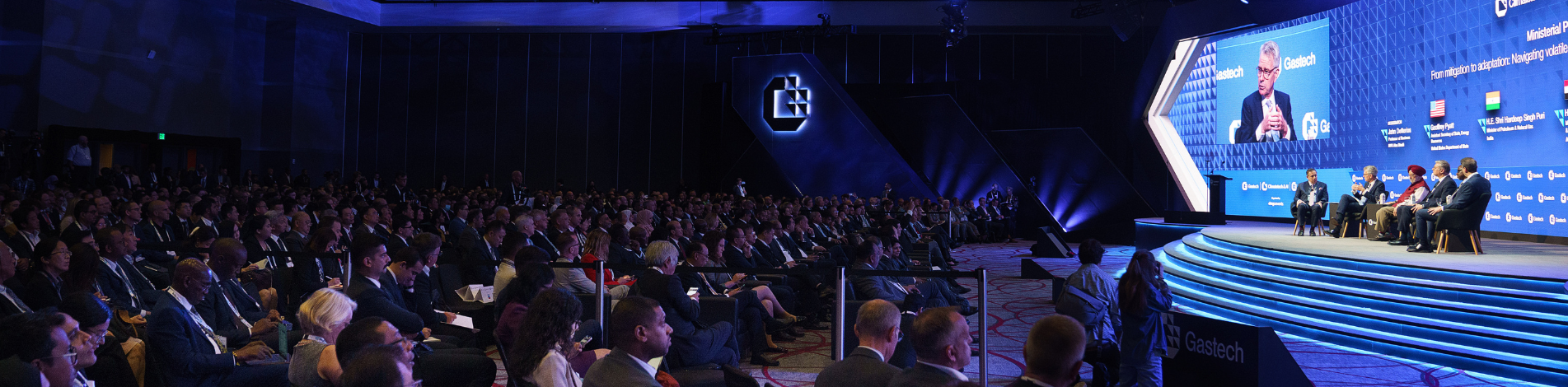
Join senior policymakers, CEOs, and industry leaders for high-level discussions on the forces transforming the global energy landscape.

Explore investment strategies, energy security, infrastructure development, and cross-industry collaboration driving the transition to a resilient energy future.

Technical & Commercial Conference

Cfp Gastech Shipping And Marinesession

Dive into the technologies and commercial solutions accelerating real-world energy transformation.

Learn from experts presenting cutting-edge innovations, engineering breakthroughs, and scalable solutions enabling a lower-carbon energy system.

Join the global energy conversation

By booking your delegate pass, you will gain access to senior decision-makers, market-moving insights, and high-level networking opportunities across the Gastech Conferences.

Member of