Discover the technologies, solutions, and companies shaping the future of energy. Connect with exhibitors across natural gas and LNG, low carbon solutions, electrification, and AI for energy.
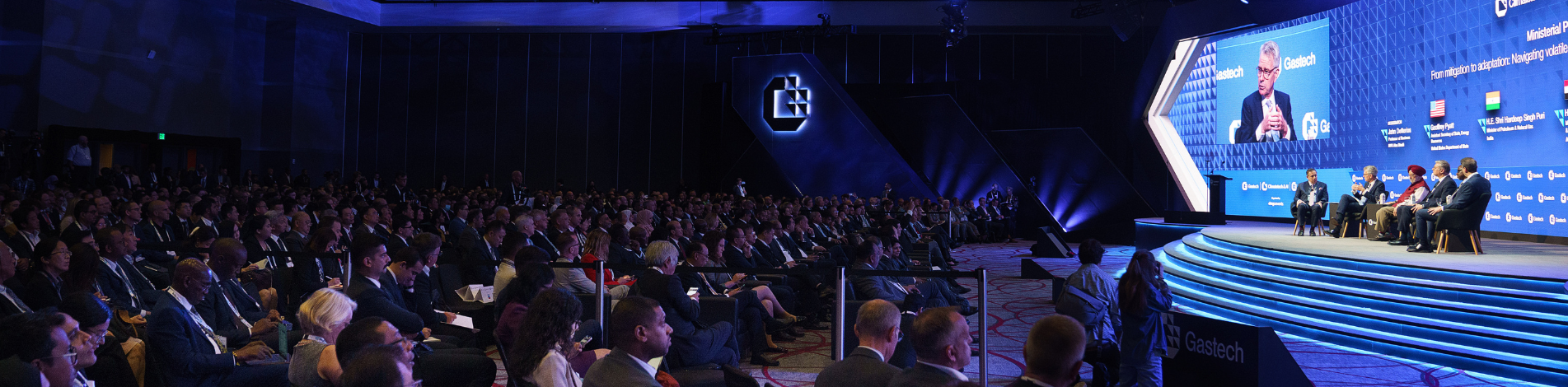
The Gastech Conferences serve as a critical platform for the industry, inspiring policy development, collective action, and knowledge sharing with the potential to drive technical innovation. These conferences are designed to support sustainable economic growth and deliver tangible global energy solutions.
The Global Energy Club is a prestigious, members-only platform uniting ministers, government officials, c-suite executives, and board members from world-leading energy companies.
Discover expert insights, interviews, and analysis from the Gastech community on the technologies, strategies, and innovations shaping the journey to net zero.
Accelerating low carbon solutions and energy‑efficiency innovation for a more resilient, lower‑emissions energy system
Low carbon solutions and energy efficiency solutions will be central to achieving measurable emissions reduction across the global energy system. Gastech will examine how these technologies can move from ambition to large‑scale deployment, integrating into complex value chains, enabling system‑wide optimisation, and supporting a more interconnected, resilient, and lower‑emissions future.
Unlocking the unrealised potential for hydrogen in a diverse energy mix
The hydrogen sector is recalibrating as early optimism gives way to natural attrition and a pragmatic reassessment of market realities. Yet the sector’s underlying momentum remains significant, with US $110bn in committed investment worldwide, and investment growing by more than 50% each year during the past five years.With natural gas and LNG still essential to the energy mix, hydrogen’s credibility will hinge on proven use cases and clear commercial viability. Progressing projects from ambitio... Read More
Monday, 14 September | 12:00 - 12:45Low Carbon Solutions Strategic
On track or off course? Navigating the path towards lower carbon energy systems
Energy transformation is entering a decisive phase. Global demand is surging and clean energy investment is approaching US $2tn annually, yet fossil fuels still supply over 80% of primary energy [IEA] and emissions reductions remain off track. Geopolitical pressures are shifting the focus from speed to durability and security, with pace and pathways diverging across regions. Lower carbon capacity is expanding, but system integration is lagging. Grid bottlenecks, gaps in firm capacity and outdate... Read More
Wednesday, 16 September | 13:00 - 13:30Inclusion & Diversity
Women in innovation: Start-ups and founders
2024 research by PwC showed that, worldwide, women-only founders received less than 2% of venture capital funding. Join our panel of innovators who are forging their careers as founders for an open and honest conversation about the challenges faced, opportunities taken, and success they have built.Speakers will share insights into their career journeys thus far, along with advice for newcomers in the industry.
Monday, 14 September | 12:45 - 13:30Low Carbon Solutions Strategic
Backing the next wave: Structuring capital to scale low carbon solutions
Capital availability is no longer the primary barrier to scaling low carbon technologies – the challenge now lies in managing the risks of early commercial projects and designing financial structures that bring solutions to market. Lower carbon projects lack stable carbon pricing and long-term revenue certainty, while nascent supply chains and complex financing add further risk. Understanding what drives project success is critical to accelerating deployment. The need is particularly urgent in A... Read More
Monday, 14 September | 16:15 - 16:45Strategic Leadership
Regulate or stagnate: The policy choices that will define the next decade
Energy regulation is becoming more interventionist, shifting focus from efficiency to capacity, resilience and strategic reserves as governments respond to volatility and supply concerns.A key challenge is funding new capacity, including gas storage, while keeping markets attractive to investors. At the same time, policy tensions are rising as ambitious methane and carbon targets test short-term feasibility, raising a broader question: should regulation enable the transition or actively force it... Read More
Tuesday, 15 September | 10:00 - 10:45Low Carbon Solutions Strategic
Banking on CCUS: What’s real, what’s next, and how to deliver at scale
Carbon capture, utilisation and storage (CCUS) is widely recognised as essential to decarbonising hard-to-abate industries, yet across Asia-Pacific no segment of the value chain has reached sustained commercial scale. The barriers are structural, not technical: a tenfold gap between full-chain costs and regional carbon price benchmarks [BCG], underdeveloped cross-border transport infrastructure, unresolved storage liability frameworks, and limited utilisation pathways that could turn captured ca... Read More
Tuesday, 15 September | 10:45 - 11:30Low Carbon Solutions Strategic
From waste to value: Using AI to turn methane and flaring into action
Methane emissions and routine flaring represent one of the most immediate opportunities to lower emissions across the energy value chain, and one of the most commercially actionable, with wasted methane equating to wasted energy and lost revenue. The Global Methane Pledge targets a 30% cut by 2030 and combined funding now exceeds US $1bn. AI and digital tools are improving detection, yet translating fragmented satellite, flaring and asset-level data into operational decision-making remains a cha... Read More
Tuesday, 15 September | 11:30 - 12:15Low Carbon Solutions Strategic
Democratising high-impact low carbon solutions in emerging markets
Emerging and high-growth economies are expected to account for around 80% of the rise in global electricity demand by 2030 [IEA], driven by energy security needs and industrial expansion. High-impact climate technologies can deliver reliable, affordable power while strengthening long-term economic resilience, yet deployment remains constrained by cost gaps, infrastructure readiness and limited access to concessional capital and risk-sharing mechanisms. The markets with the fastest demand growth ... Read More
Tuesday, 15 September | 11:30 - 12:15Strategic Leadership
AI, electrification and the grid imperative
Grid infrastructure is now central to competitiveness and AI deployment. Power demand could rise over 70% by 2050, yet transmission is lagging, creating bottlenecks that constrain industry, data centres and cross-border trade. Ageing systems face added risks from extreme weather, cyber threats and decentralisation.With renewables dominating new capacity, flexibility and storage are critical. Building resilient, digital grids will require faster permitting, major investment and close collaboratio... Read More
Tuesday, 15 September | 12:15 - 13:00Low Carbon Solutions Strategic
AI x energy security: The nuclear opportunity
AI-driven electricity demand is reshaping how digital infrastructure is powered, with data centre energy use projected to more than double by 2030 to around 945 TWh [IEA]. Nuclear energy – high-capacity, stable and low carbon – offers a strategic option for meeting continuous AI-driven load. Life extensions of existing plants and growing interest in small modular reactors appeal to policymakers and hyperscalers seeking long-term supply security, while AI-driven safety monitoring and performance ... Read More
Tuesday, 15 September | 13:30 - 14:15
A focused approach to hydrogen growth: Achieving realistic market ambitions
After its early surge in development, funding cuts and project cancellations have put pressure on the hydrogen market. However, this has streamlined the development pipeline: projects that remain are backed by solid business cases, regulatory support, and near-secure offtake, with around 80% of committed global offtake concentrated in ammonia, refining, and power [Hydrogen Council].Economies of scale remain elusive, but existing demand centres and early successes provide a foundation for growth.... Read More
Tuesday, 15 September | 14:00 - 14:45Strategic Leadership
Fuel choices and flexibility: The next phase of Asia’s LNG growth
Asia’s fast-growing economies are central to global LNG demand, even as tighter markets and higher prices strain energy systems. Urbanisation, industrial growth and rising power use are driving the need for reliable, affordable gas, while increasing sensitivity to volatility. In Southeast Asia, LNG supports grid reliability; elsewhere it competes with coal, renewables and nuclear. Sustaining demand will depend on infrastructure, diversified supply and contract flexibility in a tighter market.Aud... Read More
Tuesday, 15 September | 14:15 - 15:00
Ammonia in action: Scaling utilisation across energy, maritime, and industrial value chains
Ammonia accounts for 43% of offtake from global hydrogen projects, and half of all southeast Asian hydrogen demand [Hydrogen Council]. Its ability to decarbonise hard-to-abate industries such as steel, cement, and shipping, is a key strategic advantage. However, research shows that the maritime industry represents only 1% of binding offtake, revealing significant untapped potential [Hydrogen Council].Although high production costs are a barrier to widespread use, ammonia’s status as a globally t... Read More
Tuesday, 15 September | 16:00 - 16:40Japan Energy Strategic
Japan–ASEAN energy corridors: Scaling CCUS, hydrogen and LNG through regional integration
As Japan accelerates decarbonisation while managing rising demand, cross-border infrastructure is moving to the centre of its strategy. Japanese firms are advancing CCUS studies, CO2 shipping pilots and offshore storage partnerships across Southeast Asia, alongside LNG capacity and early hydrogen and ammonia supply chains. ASEAN markets, with strong storage potential and gas infrastructure, are becoming critical partners in diversified supply, shifting focus from bilateral projects to integrated... Read More
Wednesday, 16 September | 10:00 - 10:30Strategic Leadership
Rising economies, rising demand: How the next industrial age gets powered
Emerging markets are redefining global energy demand in both scale and character. The focus is shifting from headline growth to its durability, with industrial users increasingly at its centre. Across South and Southeast Asia, strong signals from buyers and utilities point to continued expansion driven by industrialisation, electrification, and digital infrastructure - with LNG playing a key bridging role. But translating demand signals into bankable projects remains the critical challenge. ... Read More
Tuesday, 15 September | 13:45 - 14:15Inclusion & Diversity
Women in innovation: Low carbon solutions
A 2025 study into climate technology companies found that 68% of women employees were in junior roles, compared to 31% of men, and women were outnumbered 3:2 in the C-suite [Climate Mosaic, HSBC, Extantia].Join our panel of innovators who are at the forefront of low carbon solutions development for an open and honest conversation about the challenges faced, opportunities taken, and success they have built.Speakers will share insights into their career journeys thus far, along with advice for new... Read More
Wednesday, 16 September | 14:30 - 15:00Strategic Leadership
Capturing the lost opportunity: Driving global alignment on methane abatement across natural gas supply chains
Over 75% of energy sector methane emissions could be cut with existing, often low-cost technologies. Yet uneven regulation and policy create inconsistent incentives and enforcement across regions. Embedding methane management across operations, from maintenance to procurement and capital allocation, is critical to turning data into action. Linking emissions intensity to market access, financing and buyer requirements can drive change, making methane management a core performance metric across th... Read More
Wednesday, 16 September | 15:00 - 15:30Strategic Leadership
Advancing sustainable maritime infrastructure and fleet capacity
Global shipping is at a turning point, with regulation, technology and climate goals accelerating the shift to low-carbon fuels. The IMO’s Net-Zero Framework introduces fuel standards and carbon pricing to cut emissions across most oceangoing vessels. LNG is playing a near-term role, supporting emissions reductions as alternative-fuel fleets expand. Delivering the transition will require major investment in bunkering, ports and shore power, alongside stronger coordination across industry and pol... Read More
Wednesday, 16 September | 15:30 - 16:00Strategic Leadership
Powering the impossible: Reimagining energy for hard-to-abate industries
Heavy industry, spanning steel, cement, chemicals, aluminium, shipping and aviation, accounts for nearly 40% of global emissions. Decarbonisation is constrained by energy intensity, long-lived assets, complex supply chains and mixed policy signals. Solutions exist, from electrification to hydrogen and carbon capture, but progress depends on integrated approaches. Cross-sector partnerships and new energy systems will be critical to align capital, policy and demand, turning hard-to-abate sectors i... Read More
Thursday, 17 September | 10:45 - 11:30Strategic Leadership
Building adaptable future-ready organisations through the strategic integration of an upskilled workforce and advanced technologies
The energy industry faces a talent crisis with two-thirds of new hires replacing retirees between now and 2030 [IEA]. At the same time, AI is driving rapid change to the skills required by nearly all roles, highlighting the need for comprehensive upskilling and reskilling initiatives [McKinsey]. However, many companies are hesitant to incur training costs, fearing workers will leave after learning new skills. To address this challenge, a broader, long-term view prioritising future ene... Read More
Tuesday, 15 September | 17:20 - 18:00
Scaling Japan’s ‘Hydrogen Society’: Aligning technologies, market development and geopolitical realities
Japan, the first country to adopt a national hydrogen strategy, is a leading testbed for scaling clean hydrogen and ammonia, accelerating trials and adoption across power, industry and transport under its Green Transformation strategy. However, production, storage and transport costs remain high versus conventional fuels. With Japan needing to import hydrogen amid volatile supply chains, and pricing mechanisms still evolving, momentum toward bankable markets remains limited.Which sectors are clo... Read More
Tuesday, 15 September | 11:30 - 12:15Electrification Strategic
The new power trilemma: Sovereignty, transition and competitiveness
The classic energy trilemma has been reframed by the disruptions of 2026. Economies that advanced electrification proved more resilient, while those dependent on fossil imports faced acute price and supply shocks. The question is no longer whether to electrify, but how to do so while strengthening competitiveness and strategic positioning. Sovereign clean power is now seen as a route to import independence, but the pace of transition must be balanced against stranded asset risk, critical mineral... Read More
Wednesday, 16 September | 12:00 - 12:45Electrification Strategic
Firm clean power: The strategic case for domestic clean generation
Locally produced nuclear, geothermal, hydrogen, and ammonia have become hedges against the import dependency exposed by 2026’s disruption. Small modular reactors are nearing commercial deployment with increasingly competitive costs and timelines. Advanced geothermal is unlocking new resources in markets that previously lacked viable options. Green hydrogen and ammonia are beginning to play a role in the regional power mix as both storage and dispatchable fuel. The challenge is no longer whether ... Read More
Tuesday, 15 September | 14:00 - 14:45Electrification Strategic
Storage at scale: Batteries, long-duration solutions, and grid flexibility
This year’s record strategic petroleum reserve release highlighted that storage is as much a geopolitical instrument as an operational one. Utility-scale lithium-ion batteries are scaling rapidly with falling costs, but duration and cycle life limitations create gaps that long-duration technologies must fill. Pumped hydro, compressed air, flow batteries, and thermal storage each offer different profiles, and the right mix will vary by market. The 2026 disruption has added urgency to the question... Read More
Monday, 14 September | 14:00 - 15:30Low Carbon Solutions Technical
CCUS chains: Managing specifications & impurities
Technical papers can be accessed here: https://www.gastechevent.com/technical-papers/Minimising CAPEX, maximising uptime: Optimising CO₂ compression and purification system architecture Travis Bowman, Technical Director, Siemens EnergyAs large-scale CO₂ capture and sequestration (CCS) projects for LNG facilities and related or unrelated power generation islands garner interest, project developers, EPCs, and operators are seeking clarity on how the selection of compressor and driver type aff... Read More
Monday, 14 September | 15:30 - 17:00Low Carbon Solutions Technical
Decarbonising power, LNG & data centres
Technical papers can be accessed here: https://www.gastechevent.com/technical-papers/Decarbonising gas-to-power for data centresTamás Ungár, Solutions & Proposal Manager, Capsol Technologies The rapid expansion of cloud computing and artificial intelligence is driving unprecedented growth in electricity demand. Data centres require continuous, reliable power, often exceeding the pace at which transmission grids can be expanded. As a result, gas-fired power located close to demand ... Read More
Wednesday, 16 September | 10:00 - 11:30Low Carbon Solutions Technical
Case studies & scaling solutions
Technical papers can be accessed here: https://www.gastechevent.com/technical-papers/INPEX’s low carbon solution: Demonstration and commercial CCS projects Koji Ochiai, SVP, INPEXWith INPEX’s Vision 2035, we aim to achieve a responsible energy transition focusing on a stable and sustainable supply of lower-carbon energy. We will promote lower-carbon solutions by leveraging our capabilities and technical expertise. We will reduce GHG emissions by integrating CCS into our natural gas/LNG proj... Read More
Wednesday, 16 September | 11:30 - 13:00Low Carbon Solutions Technical
Pilot plants & new technologies
Technical papers can be accessed here: https://www.gastechevent.com/technical-papers/First-of-a-kind industrial demonstration of a modular rotating packed bed (RPB) post-combustion CO₂ capture system Krishna Kumar Singhania, Chief Growth Officer, Carbon CleanConventional column-based post-combustion CO₂ capture systems face significant challenges in industrial retrofit applications due to large equipment size, height constraints, structural integration requirements, and high capital cost. T... Read More
Wednesday, 16 September | 13:30 - 15:00Low Carbon Solutions Technical
Market competitiveness & emerging technologies
Technical papers can be accessed here: https://www.gastechevent.com/technical-papers/What makes transport & storage projects competitive? A structural scoring framework beyond tariffsSohini Chatterjee, VP - CCUS & Low Carbon, Rystad EnergyEurope’s carbon capture and storage (CCS) landscape shows divergence in project maturity, regulatory certainty and investment risk. The North Sea basin concentrates the most advanced, bankable CO₂ transport and storage (T&S) systems, supported by es... Read More
Wednesday, 16 September | 15:00 - 16:30Low Carbon Solutions Technical
Reducing & analysing environmental emissions
Technical papers can be accessed here: https://www.gastechevent.com/technical-papers/A multi-method approach for estimating methane emissions from global LNG production Haichen Ji, PHD Candidate, China University of Petroleum (Beijing)Methane emissions constitute the largest greenhouse gas contributor in the liquefied natural gas (LNG) value chain, yet accurate quantification remains challenging due to intermittent emission sources and limited global measurement coverage. With LNG trade exp... Read More
Tuesday, 15 September | 15:00 - 16:30Low Carbon Solutions Technical
CO₂ liquefaction
Technical papers can be accessed here: https://www.gastechevent.com/technical-papers/Pathways of ship-based CCTS value chain targeting depleted offshore oil and gas fields Xiang Liu, Principal Engineer, ABSThe carbon capture, transportation and storage (CCTS) value chain is built on CO₂ capture technologies that separate carbon dioxide from industrial gas streams, including from sources such as cement plants, power stations and even marine vessels. Offshore environments offer long-term CO₂ ... Read More
Monday, 14 September | 16:45 - 17:15Strategic Leadership
The new LNG order: Leadership strategies for energy security and growth
As energy security climbs the global agenda, LNG is emerging as a critical enabler of economic growth, power system reliability and industrial competitiveness. Yet as the markets become increasingly complex, shaped by geopolitical tensions, shifting trade corridors, evolving carbon policies and surging power demand from AI and digital infrastructure, demand for gas and LNG is surging. With competition for supply intensifying and investment decisions carrying long-term consequences, how can indus... Read More
Wednesday, 16 September | 15:30 - 17:00Low Carbon Solutions Strategic
From methane transparency to mitigation: Practical pathways for Asia's gas markets
As methane transparency becomes increasingly linked to gas trade and climate reporting, Asian markets need practical mitigation pathways that reflect diverse supply structures, regulatory systems, and institutional capacities. This session will examine how policymakers, regulators and market actors can strengthen measurement, reporting and verification systems, interpret satellite and company data, and align emerging methane frameworks with LNG trade realities. It will highlight OGMP 2.0, fit-fo... Read More
Wednesday, 16 September | 09:30 - 11:00Low Carbon Solutions Strategic
Building cleaner LNG supply chains for Asia: From buyer signals to producer action
Asian LNG markets need secure, affordable, and near-zero-emission gas. Yet many emerging LNG and gas producers are seeking additional capacity, financing and technical support to accelerate methane reduction efforts. Convened by the World Bank Group’s Global Flaring and Methane Reduction (GFMR) Partnership and the Japan Organization for Metals and Energy Security (JOGMEC), this closed-door roundtable will bring together LNG buyers, producer NOCs, governments, and public-finance partners to ident... Read More
Monday, 14 September | 15:20 - 15:40Strategic Leadership
Growth, abundance and the courage to decarbonise
The next chapter of economic development will be shaped by a defining challenge: how to deliver more energy while accelerating the transition to net zero. With abundant hydropower, significant natural resources and growing capabilities in hydrogen and CCUS, Sarawak has an opportunity to demonstrate that energy security, economic growth and decarbonisation can advance together. In this Energy Talk, the Premier of Sarawak will set out the State’s vision for harnessing its energy abundance to build... Read More
A selection of speakers include
Explore the Low Carbon Solutions Programme
Low Carbon Solutions Strategic programme
The Low Carbon Solutions Strategic programme unites energy leaders, policymakers, investors, and innovators to advance cutting-edge strategies and technologies for measuring, reducing, and mitigating emissions. It drives commercial growth in CCUS, DAC, and breakthrough climate solutions while scaling impactful innovations.
Low Carbon Solutions Technical programme
The Low Carbon Solutions Technical programme offers cutting-edge insights into the technologies and strategies critical to achieving impactful emissions reduction. This peer-reviewed programme showcases groundbreaking applications across the carbon capture and storage (CCS) value chain, including offshore CCS and the implementation of scalable capture technologies, and provides insights into the latest Small Modular Reactor (SMR) developments.
Join the global energy conversation
By booking your delegate pass, you will gain access to senior decision-makers, market-moving insights, and high-level networking opportunities across the Gastech Conferences.
At the Gastech Decarbonisation Exhibition, leading companies and innovators will showcase the technologies driving measurable emissions reductions across the energy value chain. From carbon management and energy efficiency to digital solutions and system integration, the exhibition highlights how climate technologies are scaling from pilot projects to deployment to support a more interconnected, resilient and lower-emissions future.
The Gastech Innovation Accelerator connects start-ups, innovators and industry leaders to showcase transformative energy technologies, gain direct exposure to key stakeholders, and drive progress toward a lower-carbon future.
Start-ups can pitch solutions in climate tech, hydrogen, and AI, while industry professionals discover scalable innovations to improve operations and sustainability.
Participation is open to exhibiting start-ups, with selected innovators receiving enhanced visibility and support.